

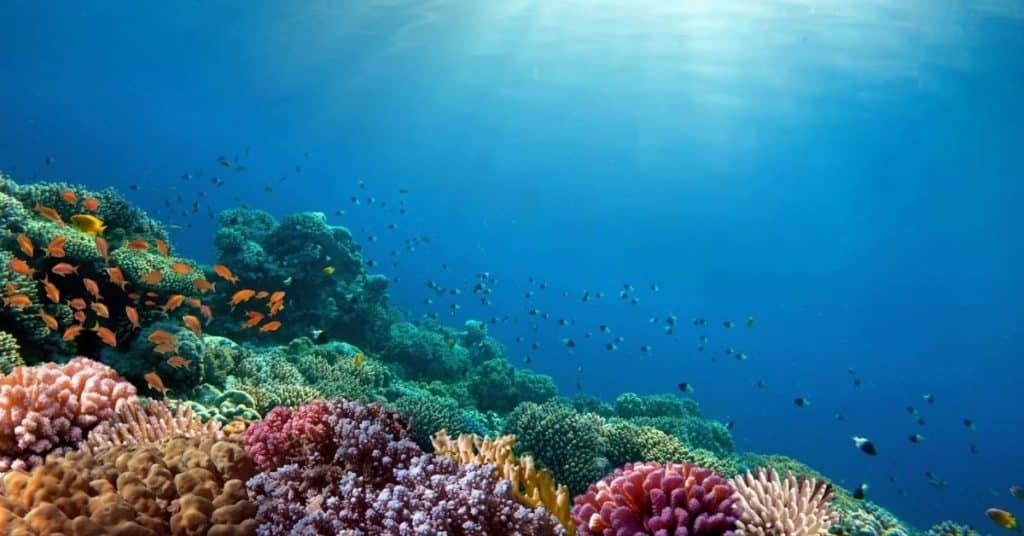


Scientists are increasingly warning that the world’s warm-water coral reefs have now crossed a global tipping point. This conclusion was recently brought into public focus by the Global Tipping Points report released in October 2025.[1] This report represents the culmination of decades of monitoring, thermal-stress modelling, and ecological observation. It shows that the combined pressures of marine heatwaves, ocean acidification, pollution, and overfishing have pushed many reef systems beyond recovery.
The significance of declaring a tipping point cannot be overstated. In ecological science, a tipping point marks the moment when an ecosystem crosses a critical threshold that leads to accelerating and often irreversible changes. In this case, once-stable coral reef ecosystems have become so degraded that they are now in danger of disappearing entirely.
The Global Coral Reef Monitoring Network reports that the world lost roughly 14 percent of its hard corals between 2009 and 2018, a decline that has only accelerated with the marine heatwaves of the early 2020s.[2] Bleaching events that once occurred every few decades now strike with increasing frequency, leaving corals too little time to recover between episodes. The Intergovernmental Panel on Climate Change predicts that most reefs will disappear if global warming reaches 1.5 degrees Celsius, and all reefs could become functionally extinct if it reaches 2 degrees.[3] According to NASA, 2024’s record-breaking heat was about 2.65 degrees Fahrenheit (1.47 degrees Celsius) warmer than the late nineteenth century preindustrial average.[4]
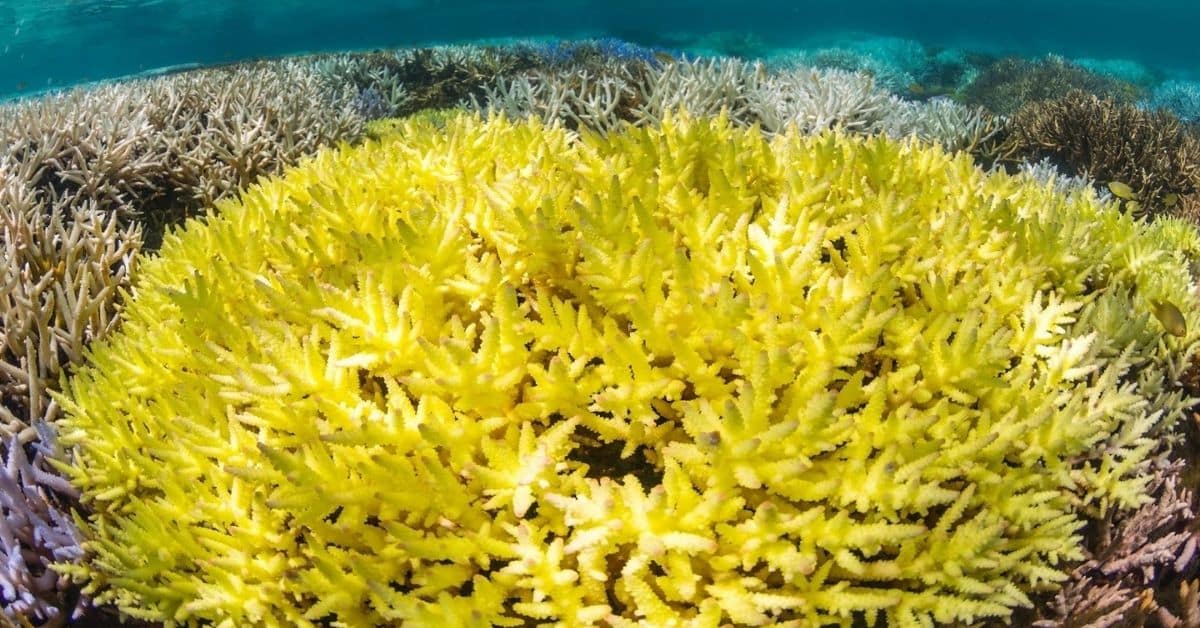
When ocean temperatures rise or pollution intensifies, corals become stressed and begin to bleach. The coral above is in the midst of a bleaching event, during which it expels the tiny symbiotic algae, zooxanthellae, that give corals their vibrant colors and supply most of their energy. Losing these algae is a last attempt to survive extreme conditions, but without them, corals can only endure for a short time. Prolonged periods without these allies ultimately lead to their death.
The loss of coral reefs represents far more than the disappearance of a beautiful ecosystem. Although they cover less than 1 percent of the seafloor, coral reefs support an estimated 25 percent of all marine species at some point in their life cycle.[5] Moreover, reefs act as natural breakwaters, absorbing wave energy and protecting vulnerable coastlines from erosion, storm surges, and flooding. Classic studies of ecosystem services have long demonstrated the immense economic and social value of reefs, from tourism revenue to pharmaceutical potential.[6] Their loss has cascading ecological, economic, and cultural consequences.
When reefs degrade, fish populations decline or shift to new regions, often leaving coastal communities without critical food sources. Tourism-dependent economies lose substantial income, while shorelines once buffered by reefs become more vulnerable to storms and rising seas. In ecological terms, degraded reefs often transform into algae-dominated systems that support a fraction of the biodiversity and human benefits they once did. These impacts are unevenly distributed: small island nations and coastal communities with limited economic flexibility bear the heaviest burden.
The role that global food systems play in reef decline must be acknowledged. The connection begins with climate change. Animal agriculture, alongside fossil fuel–intensive food supply chains, contributes substantially to greenhouse gas emissions, driving the ocean warming that has become the primary cause of mass coral bleaching.[7] Each additional increment of warming reduces the safety margin for corals, whose thermal thresholds are already being exceeded regularly.


But the link between food and reefs extends beyond temperature. Land-based agriculture, particularly poorly managed livestock operations and fertilizer-heavy crop production, drives nutrient and sediment runoff into coastal waters. Scientific reviews on terrestrial runoff and coral ecology show that excess nutrients favor algae growth, reduce coral recruitment, and weaken corals’ ability to recover from heat stress.[8] Sediment from erosion blocks sunlight and smothers coral polyps, compounding the damage from warming waters.
Seafood choices add another dimension. Fishing removes key herbivorous fish that keep algae in check, undermining reef resilience. In some regions, destructive methods such as bottom trawling or the use of explosives have caused direct and devastating damage. Over time, these pressures amplify the vulnerability of reefs already stressed by heat and pollution.
The idea that individual food choices can positively influence the future of coral reefs may seem hard to believe given this dire context, but there are steps we can take. Consumer behavior shapes demand, and demand shapes global production systems. Shifting toward diets richer in plant-based foods with lower emissions can help reduce the warming trajectory that is bleaching reefs worldwide. Avoiding seafood helps reduce pressure on herbivore populations essential for reef health. Supporting or purchasing from farms that use regenerative practices—such as reducing fertilizer inputs, maintaining vegetation buffers, and restoring wetlands that capture sediments—can also lessen the nutrient and sediment loads that drain into reef systems. Together, these shifts create the economic and political space for broader structural reforms.

The declaration that coral reefs have crossed a tipping point is sobering, but it is not a declaration of inevitable loss. The same research that outlines the danger also underscores the pathways to protect what remains. Rapid reductions in greenhouse gas emissions, combined with strong regulations on coastal pollution and well-designed fisheries management, can preserve pockets of resilient reefs and buy time for adaptation and restoration. Local interventions alone cannot counteract global heating, but where warming is limited, reefs have repeatedly shown their capacity for recovery.
The fate of the world’s reefs is entwined with the present choices we make regarding energy, land use, fisheries, and, importantly, the food we produce and consume. Coral reefs are early casualties of an overheated planet, but they are also bellwethers. Their collapse signals the dangers of unchecked ecological disruption; their protection offers a model for the collective action needed to preserve earth’s living systems.
Copyright 2025 Center for Nutrition Studies. All rights reserved.