
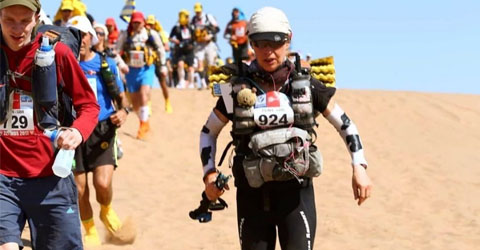
Fiona Oakes is the greatest runner you’ve never heard of. She’s a four-time world record holder in distance running, and she has completed some of the toughest endurance running challenges on earth, including the formidable Marathon des Sables, the Antarctic Ice Marathon, and the North Pole Marathon. She’s also a volunteer firefighter, and she operates Tower Hill Animal Sanctuary, which cares for over 450 animals.
Fiona does all of this without a kneecap (she lost it to disease when she was 17). You’d be hard-pressed to find anyone with as much grit or an equal amount of humility to match. We are honored to have her as part of our dairy-free team and humbled by the fact that she took time out of her intense work and training schedule to answer our questions. How does she do it all? We had to find out.
Growing Up
Fiona adopted a plant-based diet well before many of us had even heard of the notion. At three years old, she declared that she was a vegetarian, and at six, she removed all animal products from her diet. This was not due to parental influence. She grew up in a blue-collar family in the UK in which money was tight, and she was taught to be grateful for what she had.
She admitted that she was too young to fully comprehend the scope of the choice; she was simply reacting to the injustices of those she loved and felt so connected to.
I didn’t understand the intricacies and extent of the cruelty and exploitation the industry that is animal agriculture inflicts on other sentient beings. I didn’t realize the personal health benefits of being vegan, the positive impact on the planet, and the injustice of the unfair distribution of resources to other humans by feeding their grain to animals. I just didn’t want to be party to the harming of these beautiful creatures.
She grew up with grit, always involved in sport and working hard, but as a teenager, she developed a crippling disease that ultimately resulted in the loss of her kneecap. Her doctors told her she wouldn’t walk properly again. To say she proved them wrong is a gross understatement, but it reflects Fiona’s way of communicating her story: she’s not one to brag.
Finding Her Sport
Despite her almost daily twenty-mile training runs and a steady schedule of international marathons, Fiona doesn’t love running. She’s not in it for the runner’s high, to test her limits, or to find transcendence. She’s certainly not in it for the money. Fiona runs to raise awareness. She’s soft-spoken and polite—the antithesis of a rabble-rouser—but her actions and accomplishments speak louder than any raging activist with a megaphone.
She knew she wanted to help animals, and when she realized the popularity of marathons, she put two and two together and laced up. She believed that if she did well in these races, she could lead by example and prove that a completely plant-based diet was empowering, not limiting. “I have learned to let my actions articulate for me,” she remarked. Countless top finishes, four world records, and a feature-length documentary later, Fiona’s actions speak for themselves.
One Meal a Day
Athletes generally spend a lot of time thinking about fuel. Many bring energy gels on runs as short as 45 minutes. By comparison, Fiona’s one meal a day is a complete anomaly. But it works for her. “I am not really a big ‘food’ person,” she explained. “I see it only as a fuel, not a social event. For me, it seems to make sense to only eat when you are hungry, and I am only hungry at the end of a long day working at the sanctuary.”
Even on her long runs (often four hours or longer), she typically does not carry fuel. This, of course, leads to a bit of a challenge when taking on multiday endurance races such as the Marathon des Sables. She gets the fuel she needs, but she admitted that she prefers carbohydrate drinks during races.
Fiona has stuck to this regimen most of her adult life, well before intermittent fasting was a thing. It’s all about efficiency:
I just know it really does suit my digestive system very well and means that I can work through the day— whether it be at the sanctuary, at the fire station, or training—without interruption. It’s actually how I manage to cram so much into my life—coupled with waking up at 3:30am every day!
When the five hundred mouths on the sanctuary are fed and her mileage is complete, Fiona finally sits down to her simple meal, much of it made from the produce grown on her property. She explained that her mother, “a genius with fresh vegetables,” prepares the daily meal, which includes everything from seasonal fruits and vegetables, whole grains, pulses, nuts, seeds, and a lot of nutritional yeast.
Logging the Miles
Fiona is a lone wolf runner by circumstance and choice. When asked what goes through her mind during those daily hours of pounding the pavement, she responded,
Anything and everything. During my speed sessions, I don’t really have time to think. On longer efforts, sometimes it’s just “Wow, this is tough,” but other times my mind wanders all over the place: the day’s news events, my next training sessions, what needs doing when I get back to the sanctuary, something horrible I might have seen on social media, a question I have been asked or would like to ask. Basically, my running time is my thinking time, and whatever I am thinking about, I always come back more focused than when I set off.
All of this training prepares her to compete in anything from big city road marathons to adventure races. While the city events allow her to speak her message to the masses, the ultraendurance events push all her buttons. She described the first time she ran the Marathon des Sables as the most difficult race she’s endured, and it’s no wonder—it’s a six-day self-sustained race across 250 kilometers of the Sahara Desert, and she did it with two broken toes. The polar opposite of this race is the Antarctic Marathon, which she said she most enjoyed, winning in record time and smashing three Guinness world records. “A very, very sweet victory,” she remarked.
In 2019, Fiona is preparing to participate in the Gobi March and the Berlin Marathon. She described the Gobi March as “another week-long, self-sufficiency effort in the Gobi Desert.” She continued, “I love these races because they are more than about running, they are about surviving and learning so much about yourself. You go to very dark places in these events but always come out a much stronger and better person.” For Berlin, she plans on donning her cow suit—the same one in which she broke the world record for “fastest woman wearing an animal costume” at the Tromso, Norway, Half Marathon. “Why do I run some races dressed as a cow?” Fiona asked. Her answer is simple:
[So that] people ask that question, which allows me to introduce them to the horrors of the dairy industry, one which is very often overlooked and even endorsed, especially in the sporting environment. People often think dairy is healthy, and this is a myth perpetuated by suppliers, health professionals, educational and governmental bodies, and coaches and trainers alike. This idea is so deep rooted and ingrained it can be a hard one to break down, but it is one I have had great success in doing by wearing my cow costume and running well in it.
Take Nothing for Granted
Fiona’s thoughts on running kept us riveted. Some may ask why she puts herself through all that pain (remember, the woman doesn’t have a kneecap) and the stress of operating an animal sanctuary. Looking back on her childhood, the races, and all the opposition she has faced, she reflected:
[I’ve] learned to take nothing for granted, grab every opportunity and, for want of a better phrase, run with it. I think that to truly understand suffering, you have had to suffer yourself. Indeed, I do wonder if that is what drives me in the very extreme races I run, a need to remember and experience firsthand the feeling of pain, desperation, hardship, and depravity. For sure, I know it’s only a race, but as a high achiever who runs for the benefit of others and not myself, failure is not an option. To fail would be to let the animals down, to miss an opportunity to promote veganism in a positive way, and to show that anything and everything is possible to achieve without the harming of others.
You Might Also Like
Copyright 2026 Center for Nutrition Studies. All rights reserved.
Deepen Your Knowledge With Our
Plant-Based Nutrition
Certificate
Plant-Based Nutrition Certificate
- 23,000+ students
- 100% online, learn at your own pace
- No prerequisites
- Continuing education credits