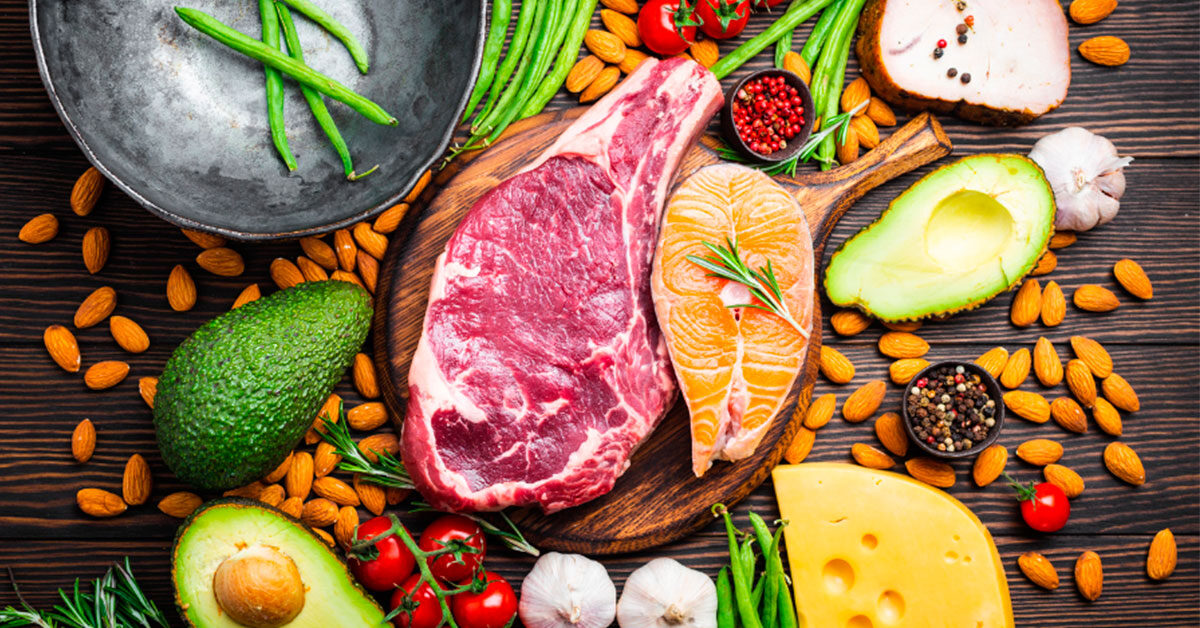


Previously in this series, I discussed the origins of the ketogenic diet and the biological role of ketone bodies (Part 1), whether living in a state of ketosis is normal and natural (Part 2), whether ketogenic diets are effective for weight loss (Part 3) or insulin resistance and diabetes (Part 4). In this installment, I’m going to examine the claim—now spreading like wildfire over the internet—that ketogenic diets can cure cancer by starving cancer cells of glucose.
Here’s a typical example of the claims made by ketogenic diet proponents:[1]
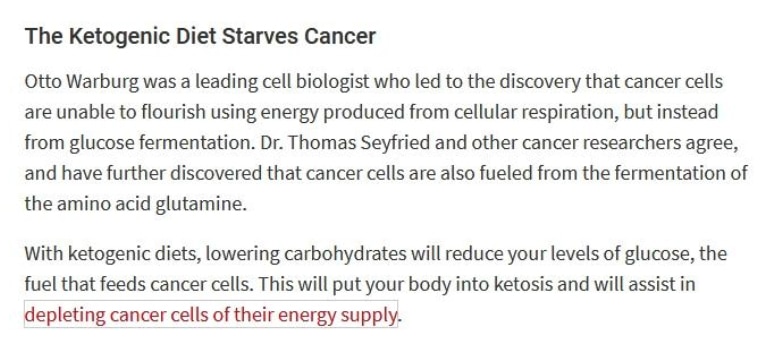
Extraordinary claims require extraordinary evidence, as astronomer Carl Sagan famously said, and this is quite an extraordinary claim. So, how does the evidence for it stack up? As you will see, not quite as well as keto-enthusiasts claim.
A 2017 systematic review of the published evidence for ketogenic diets in cancer identified fifteen studies (five case reports, eight prospective studies, and two retrospective studies).[2] They found no studies with methodologically rigorous designs and concluded, “Evidence supporting the effects of isocaloric ketogenic dietary regimes on tumor development and progression as well as reduction in side effects of cancer therapy is missing.” The reviewers also commented that researchers appeared to underreport side effects and downplay the decreased quality of life associated with following ketogenic diets.
Another review, published in 2018, concluded, “The limited number of studies and differences in study design and characteristics contribute to overall poor quality evidence, limiting the ability to draw evidence-based conclusions.”[3] In fact, the authors’ extensive literature search identified a total of only fourteen studies on the effects of the ketogenic diet in cancer patients; these studies were published between 1988 and 2016 and included only 206 individuals. Five of the studies were case reports, considered the lowest level of evidence in medical research. Patients were put on ketogenic diets for periods ranging from five days to one year. Nine out of the fourteen studies assessed the effects of the diet on tumor metabolism, disease progression, or both; of these nine studies, two found that patients on the ketogenic diet had worse results, two showed mixed results, four reported no difference between treatments, and one demonstrated an alteration in cancer cell metabolism.
A 2017 study not included in either of the systematic reviews described above involved pancreatic and lung cancer patients.[4] Its results were inconclusive because most of the patients had difficulty maintaining compliance due to the diet’s mild to severe side effects: constipation, fatigue, bloating, nausea, dehydration, esophagitis (inflammation of the esophagus), and hyperuricemia (excess uric acid in the blood).


The notion that a ketogenic diet might be an effective cancer therapy rests on the observation that the mitochondria of cancer cells act differently from the mitochondria of other cells. You might recall from your biology classes that mitochondria are commonly known as the “powerhouses” of cells. Known as the Warburg effect after Otto Warburg, who won the 1931 Nobel Prize for Physiology or Medicine, these mitochondrial differences can result in cancer cells taking up more glucose from the bloodstream.[5]
Many have misconstrued this observation to claim that “sugar feeds cancer,” which forms the basis of their advice to eliminate all forms of carbohydrates from the diet, including fruit, whole grains, and legumes—foods that have been shown to reduce the risk of developing cancer.[6-8]
The phenomenon we call cancer is not a single disease. Not all cancer cells are avid consumers of glucose, as ketogenic diet advocates claim. In one study, researchers found that of thirty-three human cancer cell lines, all of them expressed ketolytic enzymes that enabled them to take up ketone bodies and use them as fuel.[9] The level of expression varied, meaning that some cancer cell types have a stronger preference than others for using ketone bodies. They also found that cancer cells with high glycometabolism (use of glucose as fuel) didn’t necessarily have a lower level of key ketolytic enzymes. In other words, some cancer cells can use glucose and ketone bodies interchangeably.
Cancer cells that show a strong preference for using ketone bodies may cause the body to make more ketones to fuel their growth. For example, people whose cancers express the BRAF V600E mutation could be pouring fuel on the fire by adopting a ketogenic diet. In mice implanted with human melanomas expressing that mutation, a high-fat diet “increased growth rates, masses and sizes of tumors.”[10] In addition to occurring in melanomas, this type of mutation also occurs in colorectal cancers, hairy cell leukemias, and multiple myelomas.[11]
Researchers have also identified a reverse Warburg effect[12] in which fibroblasts “feed” ketone bodies to adjacent cancer cells, stimulating tumor growth and metastasis (fibroblasts are the connective tissue cells that produce the extracellular matrix in which all cells, including cancer cells, live). The human MDA-MB-231 breast cancer cell line has been found to overexpress key enzymes involved in ketone metabolism.
Here is how some researchers describe the two-way relationship between cancer cells and surrounding fibroblasts:[12]
Ketogenic fibroblasts promote the growth of adjacent breast cancer cells by driving increased mitochondrial biogenesis. Thus, the tumor stroma may serve as a reservoir for ketone body production, while cancer cells upregulate the enzymes required for ketone body re-utilization, driving oxidative mitochondrial metabolism (OXPHOS) in epithelial cancer cells.
Another team of researchers conclude, “Ketone bodies behave as onco-metabolites, and we directly show that the [ketolytic] enzymes HMGCS2, ACAT1/2 and OXCT1/2 are bona fide metabolic oncogenes.”[13]
Moreover, an enzyme involved in the generation of ketone bodies was found to be upregulated in high-grade prostate cancer.[14] And the concentration of the ketone body β-hydroxybutyrate was higher in these cells. This indicates that aggressive prostate cancer cells use ketone bodies to “gain a survival advantage allowing them to become increasingly aggressive and gain androgen-independent properties.”
This is critical because conventional prostate cancer therapy includes androgen blockade, but androgen deprivation decreases the ability of prostate cancer cells to take up glucose from the bloodstream and use it as a fuel. This “decrease in the activity of the glycolytic pathway places prostate cancer cells under stress to generate energy in a quick manner in order to carry out necessary cellular functions. One avenue through which such an effect can be achieved is to increase energy production through the breakdown of fatty acids via the β-oxidation pathway”—that is, by using ketone bodies.
Ketone bodies were also found to increase the growth rate of HeLa cells, a cervical cancer cell line used extensively in cancer research.[15]


The cancer-controlling effects of ketogenic diets are often attributed to the ketone bodies themselves. For example, improved mitochondrial function has been found to inhibit cancer cell growth and reverse the resistance of cancer cells to chemotherapy drugs.[16] Ketogenic diet advocates credit the ketone body β-hydroxybutyrate (BHB) for improving mitochondrial respiration.[17]
There is no evidence that a ketogenic diet protects against the development of cancer, and evidence for its benefits in cancer treatment is sparse and inconsistent.
However, research by Dr. Valter Longo and his coworkers on fasting and fasting-mimicking diets indicates that ketosis is not required to improve mitochondrial function.[18] Moreover, reduced levels of insulin-like growth factor 1 (IGF-1) and mechanistic target of rapamycin (mTOR) induce differential stress sensitization—a condition in which cancer cells are weakened (and therefore more susceptible to chemotherapy), while normal cells are strengthened and resistant to chemotherapy. Both IGF-1 and mTOR are reduced by fasting and the appropriate consumption of protein, as provided by a whole food, plant-based (WFPB) diet.
Fasting has been found to decrease the side effects and improve the effects of both conventional cytotoxic chemotherapy and tyrosine kinase inhibitors.[19][20] Cycles of fasting followed by refeeding stimulate the rejuvenation of stem cells, including those in bone marrow, allowing blood counts to bounce back faster after cytotoxic chemotherapy.[21]
There is no evidence that a ketogenic diet protects against the development of cancer, and evidence for its benefits in cancer treatment is sparse and inconsistent. In stark contrast, a WFPB dietary pattern not only reduces the risk of developing cancer (both because of the cancer-fighting plant foods it includes and the cancer-promoting animal foods it excludes) but also shows promise in treating at least certain types of cancer.[22]
A randomized controlled trial of a low-fat, high–complex carbohydrate plant-based diet (the direct opposite of a ketogenic diet) was shown to (1) significantly decrease prostate-specific antigen (PSA) scores, a measurement used to detect prostate cancer, (2) dramatically reduce the risk of progression in men with early stage prostate cancer, and (3) favorably affect a wide range of genes involved in cancer.[23]
Water-only fasting followed by a WFPB diet with no added sugar, salt, or oil—again, high in complex carbohydrates, low in fat, and relatively low in protein—has been shown to shrink lymphoma and maintain remission.[24]
Finally, research consistently indicates that diets rich in minimally processed plant foods promote healthy longevity.[25] In an email exchange about ketogenic diets (shared with his permission), Dr. Valter Longo’s colleague and coauthor Dr. Sebastian Brandhorst made two critical points:
In other words, the ketogenic diet is not conducive to human longevity and does not offer the benefits that fasting (and plant-based diets) provide for cancer patients, in terms of reducing the side effects of medical treatment and enhancing its effectiveness.
The extraordinary claim that ketogenic diets cure cancer is supported not by extraordinary evidence but a patchwork of conjectures and hypotheses about the metabolism of cancer cells.
Learn more about the ketogenic diet from the previous articles in this series:
Part 1 – What Is the Ketogenic Diet?
Part 2 – Is the Ketogenic Diet Natural for Humans?
Part 3 – Does the Ketogenic Diet Really Work for Weight Loss?
Part 4 – Can the Ketogenic Diet Reverse Type 2 Diabetes?
Copyright 2026 Center for Nutrition Studies. All rights reserved.